Credit analysis and credit risk
Professor Fernando Diz
>
The Corporate View of Capitalization Structure
An understanding of all of the factors that affect the capital structure "decision" requires that you understand the conceptual differences that exist when one takes the corporate point of view to capital structure rather than the views that we have previously discussed, which we will refer to as the academic view.
The academic view is "shareholder centric" insofar as it predicates (implicitly) that corporate behavior responds exclusively to the needs and desires of outside passive minority investors (OPMIs), or put in a different way, the implicit assumption is that there is a substantive consolidation of OPMI and corporate interests. Although the idea has some appeal in the context of a privately owned company, for a public corporation it is utterly unrealistic and ignores the multiplicity of constituents whose communities and conflicts of interest with the corporation have (perhaps a more important) bearing on the capital structure decision. One needs only to list a few examples of when OPMI needs and desires are in conflict with corporate interests:
*
1.
OPMIs desire for cash dividends or cash distributions even when the corporation may have much better uses for such cash is a clear example of one such conflict of interest between OPMIs and the corporation itself.
*
2.
OPMI short-run desire for the largest amount for reported earnings even if those higher earnings mean higher income tax bills than would otherwise exist.
In fact, the mass of OPMIs may demand information, or assert their right to discuss and criticize at annual meetings, but they cannot govern or control a single corporate decision. I hope you now realize how preposterous the assumption of substantive consolidation is.
V
Factors Affecting Capital Structure
V
The factors affecting the capitalization structure of a public corporation include the following:
V
1.
The composition and characteristics of the assets that offset the capitalization.
To understand this point think about it this way: asset management is a function of liability management or liability management is a function of asset management.
What amount and types of liabilities a company selects to be in their capitalization will be related to having the assets that will produce the resources to service such capitalization. Liabilities can be serviced from three different sources:
(a)
internal cash flow generated from operations,
(b)
the sale of assets, and
(c)
access to capital markets for new financings.
These are the three sources of credit support for a given capitalization. We shall be talking about these later on.
Insurance companies provide a good example of "asset management being a function of liability management". Insurance companies' assets consist primarily of investments in debt instruments and other securities. The bulk of their liabilities depend on whether they are Property and Casualty or Life insurers.
Life insurers principal liability consists of future claims on their life policies. These liabilities tend to be actuarially determined with a relatively high degree of accuracy. Thus, the size and timing of these liabilities are known with reasonable certainty. Because these liabilities are known and tend to be long-term, Life insurance companies' investments assets normally consist of long term privately placed loans.
Property and Casualty insurers, on the other hand, are subject to dramatic and unpredictable demands for cash arising from claims from policyholders that arise from natural disasters like hurricanes or earthquakes.
*
2.
The needs and desires of the several classes of creditors.
*
3.
The needs and desires of regulators.
*
4.
The needs and desires of credit rating agencies.
*
5.
The needs and desires of managements and control groups.
*
6.
Custom and usage
*
7.
The professional advice of investment bankers, attorneys, and accountants.
*
8.
The desires of OPMIs and their representatives.
V
Understanding Credit and Credit Analysis
>
Credit Risk
*
Credit risk: the probability that a money default will happen. Broadly speaking the are two types of events of default. Money defaults and non-money defaults. We shall define credit risk as the probability that an issuer fails to pay when payment is due; i.e. a money default.
*
The difference between credit risk analysis or credit analysis and distressed analysis is “equivalent to predicting whether a storm is likely to happen while waters are calm, and trying to steer a ship in the middle of the storm” (Steve Moyer). In this class we shall superficially study credit risk analysis, in the NYC Distress Seminar in May 10-14, 2021, we study distressed analysis.
V
Credit risk is a function of three factors:
*
Leverage
*
Priority
*
Time
>
Understanding Leverage
*
To understand leverage one must first understand the sources of credit support. Leverage and credit support are two sides of the same coin. Low levels of credit support imply high levels of leverage and vice-versa. So remember, low credit support = high leverage, and high level of credit support = low levels of leverage. The sources of cash used to repay debt (interest and principal) as it comes due are:
V
Credit support comes in three different forms:
*
1)
Cash flow from operations
*
2)
Collateral value (the value of assets that can be sold and can be pledged as security)
*
3)
Access to capital markets (the ability to either refinance or raise additional capital)
V
What are the considerations of lenders when they lend money regarding "leverage" or credit support?
*
Are cash flows adequate to support the loan?
*
Are they very volatile or stable?
*
Who do they have to share the cash flows or support with? (other claimants)
V
If cash flows are inadequate or too volatile or have to be shared with others, the lenders will also require other sources of support, notably pledges of collateral. The borrowers will grant security interests in the collateral (i.e. ownership). This gives rise to what is known as ”secured" credit.
V
Examples of secured credit:
*
A loan secured by a Mortgage. The mortgage is a security interest in real property held by a lender as security for a debt.
*
Working capital lines secured by inventory and receivables (borrowing bases defined as a percent of the value of inventory and receivables).
*
Depending on the type of "credit support" contractually given by the borrower to the lender we have two types of lending: secured and unsecured. Unsecured credit is credit given based on the overall ability of a company to repay. Viewed from the point of view of the lenders, they will have secured claims on the company assets or unsecured claims. (bankruptcy jargon).
*
Let us talk a little more about "secured credit". Secured debt is debt secured by a "lien" on property in which the borrower (debtor) has an ownership interest. A lien is a security interest given by the borrower to the lender. This security interest is given through a "security agreement" that is usually contained in the loan agreement document. Where do you find loan agreements? [as part of 8K reports] Sometimes, you can find useful information in this section of a loan agreement about the appraised value of the property used to secure the loan.
*
The debt (a company liability and the creditor's claim) is secured to the extent of the value of the creditor's interest in the borrower (debtor) property. This is just precise legal language to say that (a) the borrower can only pledge property to the extent that it is owned, and (b) the extend of security to the lender has to do with the value of the pledged property. If the value of the lender's claim is larger than its interest in the collateral, then the creditor is said to be undersecured. If the value of the collateral (property pledged) is higher than the value of the lender's claim, then the lender is said to be oversecured.
*
One term that should prove useful to know is "encumbered" and "unencumbered" assets. Encumbered assets or property is that property which has been pledged as collateral to others. Unencumbered assets are those which have not been pledge as collateral and can be used. Unencumbered assets increase credit capacity.
V
Based on these three sources of credit support we have three different measures of "leverage"
V
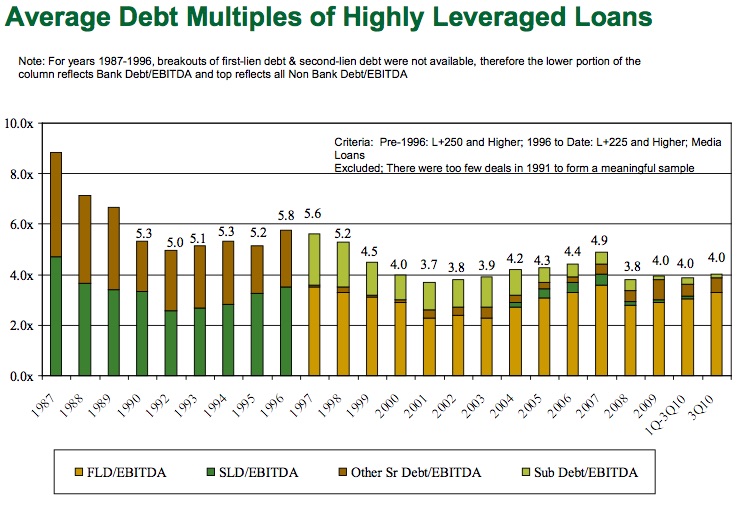
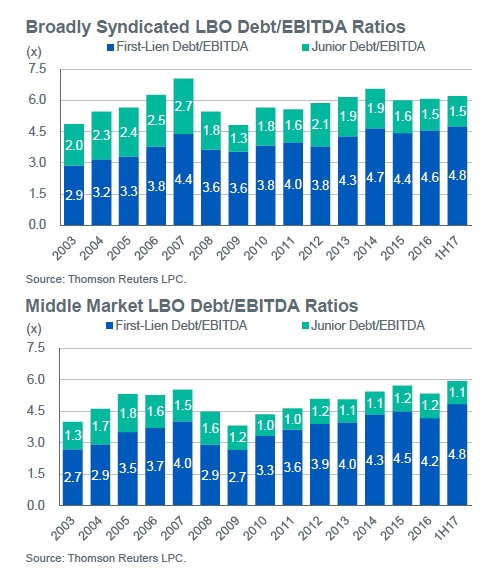
An operating or "cash flow" measure of leverage; Amount of Debt Outstanding ($) / EBITDA ($/year). This is a multiple measure whose unit of measurement will be the number of years it would take for the amount of debt outstanding to get repaid out of EBITDA. The larger the number, the lower the cash flow support. Different lenders define limits to what they will lend based on this ratio. Lenders use GAAP numbers to define limits to a company's indebtedness. Example:
LSTA-Multiples1
*
Another cash flow support measure is times interest earned, a measure of how many times we can pay interest with a given cash flow; i.e. EBITDA / Interest Expenses.
V
An asset support or collateral measure of leverage. Amount of Debt Outstanding / Total Assets. Or the debt/asset ratio. Often, a further dissection of this measure only includes "tangible" assets instead of total assets. This measure is not as useful as one may think for various reasons:
*
It is normally calculated with the GAAP value of assets. In many occasions, this value may be grossly inadequate (say income producing real estate) as an appraisal of collateral support since GAAP value may not even approximate the value of the assets in liquidation, or in a transaction where there is a willing buyer.
*
A company may have very little "tangible" assets even though the "going concern" value of those assets may be quite large. Using GAAP assets we miss how valuable those assets are in operation entirely and we get a distorted idea of the true amount of asset support. Along these lines of thinking we may argue that a better measure of asset coverage would then be: Amount of Debt Outstanding / Enterprise Value. Unfortunately, enterprise value is not something you can count on in a liquidation. You cannot put a "lien" on enterprise value and foreclose on your property. However, it could be an indicator of how much access to capital markets the company may have.
*
In multilayered corporate structures, this measure does not tell us much since all debt may be concentrated in an operating subsidiary and only the assets of such subsidiary are the ones that count, not the assets of the consolidated corporation. This is just another way of saying that it is important to know "who did the borrowing within the corporate structure and where the tangible assets are in the corporate structure". More on this later.
*
Finally, we have no good or universally accepted way of measuring access to capital markets. One such measure could be an issuer credit rating from one of the major credit rating agencies, another one is the generation of earnings. However, access is difficult to predict since capital markets can be "highly capricious". Think of Lehman Brothers for example and how lack of access put them in Bankruptcy.
>
What is credit capacity and how does it relate to leverage?
*
Credit capacity: how much debt can a firm incur prudently. Note that the word prudently really means that the question of credit capacity cannot be answered in an "absolute" manner because it always depends on how much "credit risk" both borrower and lender are willing to assume. The issue of credit capacity typically applies to unsecured lending in that debt will have to be supported from the firm's operating cash flows alone, while secured lending will have an extra layer of credit support given by the collateral pledged.
*
The advance rate on the collateral will depend on the quality of the collateral (the ability of converting the collateral into cash with minimum loss and in a timely manner), and the stability of its value over time. Even with good collateral, secured lenders must consider the ability of a company to pay also.
*
Even though it may seem that requiring collateral support on top of cash flow support means double the amount of "security", one must realize that in case the company where to file for Chapter 7 liquidation, the company would cease generating cash flow from operations and the only credit support would be the value of the collateral in liquidation.
V
Ultimately, the criteria used by secured lenders to extend credit will depend on:
V
1.
Ability to pay (cash flow support)
*
Case0451
V
Extractable EBITDA: Reported EBITDA may not be a good measure of credit support for a raider. There may be "lots" of waste in a corporation which when eliminated would create lots of extra credit support. Page 273 of Predator's Ball!.
*
"Why is this company worth fifty dollars a share three months after decided to sell stock at thirty two? This Company [Beatrice] spent hundreds of millions on things an owner-manager might not spend money on. The company spent as much as seventy million dollars a year sponsoring races. Elimination of 70 million dollars a year in cash outflow increases your value by a half a billion dollars a year. The company spent thirty to fifty million dollars on corporate image advertising, so that people would know what Beatrice was. Maybe as an owner you feel it is not important to know what a Beatrice is. You think knowing what Tropicana orange juice and Samsonite luggage [Beatrice products] is good enough. And so there can be another three to four hundred million a year."
*
2.
Meaningfully repay principal over time. (cash flow support over and above payment of interest). This reduces the lender exposure, and minimizes the risk of default if the borrower needs to refinance.
*
3.
Ability to refinance at maturity (access to capital markets, which may be related to keeping certain credit rating, or earnings)
*
4.
Maintaining asset value (collateral value)
*
All these factors tend to be very different in the case of debenture financing (unsecured financings) that seldom have an amortizing feature and whose repayment depends almost entirely on the company's ability to refinance or raise more capital to repay the original principal.
*
As you can see, the amount that a company could borrow on a secured basis will depend on quite a few things that will be dependent on both the borrower and the lender. This goes to the heart of the capitalization structure!! A company will be able to borrow NOT what it wants but what lenders will be willing to lend.
*
Exercise: Use the spreadsheet to see how different conditions (interest rates, EBITDA, tax rates, Capex, etc. may affect the amount Banks may want to lend)
>
Priority mechanisms and the allocation of credit risk
V
We have studied the factors that determine the amount of debt that:
*
1. A debtor may want to borrow.
*
2. A lender will be willing to lend.
*
We have not seen, however, how credit risk is allocated between several classes of claims within a capital structure. In our spreadsheet example, we could have made payments to the debentures BEFORE any loan amortization. Why did we not do that?
*
The primary method by which credit risk is allocated within a capital structure is through the use of priorization mechanisms. Priority controls the order of repayment.
V
There are four primary techniques for determining payment priorities:
*
a)
Grants of collateral
*
b)
Contractual provisions
*
c)
Corporate structure
*
d)
Maturity structure
V
Grants of collateral
*
They give rise to secured credit and we have discussed it previously.
V
Contractual provisions
*
A straightforward way of providing priority is through a contractual provision such as a subordination agreement. A subordination agreement, contained in either the loan agreement or a debenture indenture, is an inter-creditor agreement whereby a creditor agrees to be subordinated in right of payment to other creditor. These subordination agreements survive in Chapter 7 and 11.
*
The law assumes that all liabilities of a company have the same priority of payment, unless the holders of those claims explicitly agree to reduce their priority of subordinate their claim.
*
When reviewing subordination provisions it is important to know exactly what claim is subordinated to which other claim. And key to consider is to review documents to ascertain whether the obligation in question is or is not subordinated to "non-debt" claims like "trade claims". All this is important because a capital structure may contain liabilities that are subordinated to other liabilities but not all.
*
Look for the words "Senior", "Junior", and "Subordination" in loan agreements and debenture indentures.
V
Corporate Structure
V
Another way of assigning priorities is through the placement of debt at different levels in the corporate structure. Corporate structures arise out of:
*
(i)
The needs for insulating a parent company from the liabilities of a subsidiary;
*
(ii)
To manage disparate operating businesses,
*
(iii)
Financial reporting,
*
(iv)
Organizational accountability,
*
(v)
Create or reinforce capital structure priority differences.
*
For example a parent company may want an insurance subsidiary to have the highest credit rating and for that reason the insurance subsidiary must be debt free. The borrowing may be done at the parent company level instead of at the subsidiary level. Bottom line, in general, non-operating parent or holding companies own a variety of non-operating and operating subsidiaries. Example: Berkshire Hathaway, GE, etc.
*
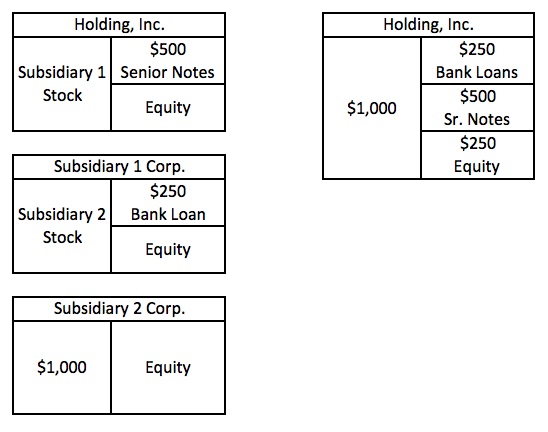
Example:
*
Corp-Structure1
*
In the figures above we see the effect that corporate structure will have on the assignment of priorities. On a consolidated basis, one may think that the bank loan may have priority over the senior notes. Suppose (and sty in the consolidated view of the company) that the Senior Notes were the first borrowing were that the company undertook. If the loan lender want seniority over the Senior loan, they would have to get it through their agreement to be subordinated to them in right of payment. Something that would be very difficult to achieve practically. However, if the loan is taken by subsidiary 2, then the loan have "priority" of payment over the senior notes because by operation of law, value flows up in accordance with stock ownership.
V
So, in the event that a Chapter 7 liquidation is filed what would happen is:
*
Assets in Sub 2 are sold.
*
The proceeds from the sale are used to pay the creditors is Sub 1 first.
*
What remains after paying creditors of Sub 1, go to pay creditors of Holding Corp.
V
Lenders will seldom allow the operation of law to control the outcome of events. Whenever possible they will try to implement "overrides" to the operation of law like:
*
Subordination agreements.
*
Grants of security interests.
V
Grant of guarantees.
*
Providing guarantees is a common business practice that can enhance the borrowing capacity of a corporate group. A corporate group member becomes the guarantor of the debts of another. Depending on who gives the guarantee to who you have "upstream", "downstream" and "horizontal" guarantees. Upstream guarantees happen when a subsidiary guarantees the debts of a parent. Downstream guarantees happen when a parent guarantees the debts of a subsidiary. Horizontal guarantees are guarantees provided by a subsidiary to another subsidiary.
*
Non-recourse provisions. (opposite to a guarantee) A non-recourse provision, typically found in secured loans, states that in the event of a default on the loan, the lender cannot (has no right) to attempt to recover from other persons (i.e. a subsidiary, management, etc.)
V
Maturity Structure
*
Maturity structure is generally a more important consideration when analyzing the characteristics of debentures and bonds. Why? Loans are generally floating rate, require significant amortization over time, and have extensive covenant protections. Since debentures rely mainly on the issuer's ability to refinance as the sole form of credit support, their maturity structure is key to their credit risk.
*
From the issuer's perspective, the longer the maturity the better, and they are likely to be willing to pay much higher interest to get longer maturities.
*
From the lender's perspective, the longer the maturity, the longer they are exposed to adverse credit developments.
*
This tension is exacerbated and creates financing challenges for companies since Senior lenders will not want relatively junior loans or bonds to mature or otherwise be repaid prior to the repayment of the Senior loan. A Senior creditor never wants the erosion of its credit support and using cash to repay a junior lender will do exactly that.
*
Credit rating agencies tend to disregard term structure.
>
How capital structures manage credit risk
*
Once loans are made and/or bonds and debentures issued, the debtor could do things that may materially modify the amount of credit risk that the lender thought was exposed to. Suppose that the company uses the proceeds of a loan for non-productive purposes? All of a sudden, the amount of credit support is reduced considerably since the use of funds does not generate any increase in enterprise value either through current or future increases in EBIT. Remember what is required of the investment decision to increase enterprise value
*
dEV / dCapex >= 1 but in our case dEV / dCapex = 0
*
Lenders manage this risk through the contractual incorporation of "covenants" in the loan agreements and indentures to restrict the flexibility of a company from doing things that may materially increase credit risk and provide the basis for monitoring the loan:
V
Covenants: GAAP as a building block
V
Financial (these are calculated on the basis of GAAP numbers)
Debt ratio: defined as Debt/EBITDA.
Interest coverage ratio: EBITDA/Interest Expenses
Debt service coverage ratio: EBITDA/(Interest Expenses + Scheduled Principal Repayments)
Fixed charges coverage ratio: EBITDA/(Service coverage + Capex, Dividends, etc)
Capital expenditures: limits on the max CAPEX.
V
Affirmative Covenants (things that the borrower must do)
Disclosure: this is a key covenant that allows the lender to monitor the borrower with information not available to the public.
Visitation rights
Maintenance of insurance
Substantive consolidation: this covenant requires that the borrower take action to minimize the risk of substantive consolidation in bankruptcy.
Use of proceeds: makes sure that the borrower uses the proceeds for what it represented it would.
V
Negative Covenants
Negative pledge: restricts the borrower's granting of security interests in assets.
Debt: restricts the amount of total debt that the borrower can borrow.
V
Fundamental changes
Mergers
Acquisitions
Dispositions
Sale leasebacks
Guarantees or Contingent Liabilities
Dividends
Affiliate transactions
V
Enforcing the Loan: Events of Default and Remedies
V
Events of default
Default in payment
Inaccuracy of representations
Breach of covenants
Cross-default
Cross-acceleration
Change of control
Invalidity of guarantee or liens
Material adverse change (MAC)
V
Remedies
Stop lending
Terminate commitments
Accelerate
Demand payment from guarantors